Let's build elections our children can check for themselves.
You are the reason this works. Secretaries of state and commissioners, election directors and clerks, elections IT and security officers, poll workers and partners — this library is written for you, not about you. Start with the welcome cut, then take whatever you need.
Start here
Just over two minutes, in plain language: what this is, what it will never do, what the public can watch while an election runs, and how the plan protects your office while the evidence proves itself.
The rest of the video library
Same story, three lengths and shapes. Use whichever fits the room you are in.
The complete walkthrough
All eleven panels, narrated end to end: the gap in today's records, the four proof properties, the privacy wall, the role views, deployment posture, the pilot path, and the published limits. Built for a sit-down briefing with officials or counsel.
For phones and quiet rooms
A 9×16 cut of the welcome with captions burned into the picture, so it reads with the sound off — on a phone, in a hallway, or dropped into a group chat with the people you want beside you on this.
Documents you can hand to someone
The implementation guide is the welcoming one — written for your team. The other two are for the people who will ask harder questions.
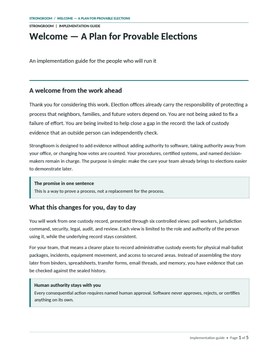
Welcome — A Plan for Provable Elections
Written for the people who will run it. What changes day to day, what it will never do, how the proof works in plain language, what we ask of you and what you can expect from us, a simple way to begin, and where we are honest about the limits. Editable Word file, so your office can adapt it.
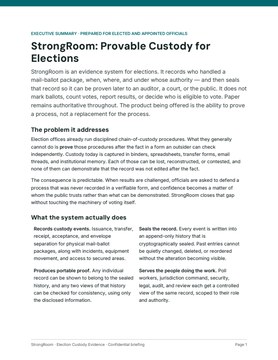
Provable Custody for Elections
The written case, with the proof model and the privacy boundary explained in full. Send this ahead of a meeting with an elected official, a general counsel, or a security reviewer.
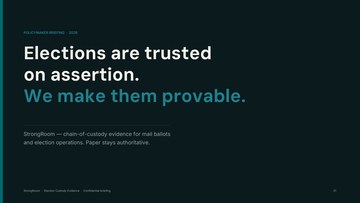
Policymaker briefing deck
Caption-only slides, one idea each. Present it, or leave it behind on a desk. It is the same spine as the videos.
What the public gets to see
Trust is not something an office should have to ask for. The design intent is that the process is observable while it is happening, and that a voter can check their own envelope without anyone being able to check it for them.
An election you can follow, essentially live
Sealed custody events publish as they are recorded, so observers, parties, press and the public can follow how ballot packages are being handled while the election is underway. What publishes is the handling — counts, times, attestations — never contents, and never anything about how anyone voted.
One question, answered only for you
A voter holding their own envelope token can ask whether that envelope has been received, and see the time it happened. Nothing about selections, no way to look up anyone else, and nothing that reconnects a person to a ballot.
Both of these are design intent, not shipped and reviewed features. The honest tension: anyone who holds a token sees the same answer, including a print vendor or someone who takes an envelope from a mailbox. So the check is rate-limited, returns acceptance time only rather than the separation instant, and is explicitly on the list for independent review before it goes anywhere near a real election.
The plan we are following
Deliberately gentle, in this order, with a real gate between each step. Nothing about your count, your certification, or your authority changes.
Election counsel first
Before anything else, a legal opinion on whether this custody and audit evidence is permissible outside certified voting-system boundaries. That question gets answered before scope moves.
One shadow environment
Custody evidence runs beside the systems you already use, on synthetic and training material. No binding role, no system of record, nothing that touches results.
Your procedures lead
We fit the record to how your office actually works, and your team tells us where it helps and where it gets in the way.
Independent review, then growth
Outside cryptographic review before anything expands, and one environment proven end to end before a second is ever discussed. Slow is the feature.
Where we are honest with you
A system whose whole value is honest evidence cannot afford to overstate itself. These limits are published rather than managed, and you will hear them from us before you hear them from anyone else.
We say tamper-evident, not immutable, not unhackable, and not blockchain-proof. The record makes changes visible; it does not make them impossible, and it does not manufacture truth.
Paper stays authoritative throughout. This system does not mark ballots, tabulate votes, report results, or decide voter eligibility, and it never decides whether a ballot is valid.